Knowledge Base › Self-knowledge
Self-discipline: why it isn’t a question of willpower

It didn’t work out again. You fell asleep with your phone after all, the running shoes stayed in the corner, and the hour of work you had planned turned into twenty minutes. The conclusion is close at hand: I just don’t have enough self-discipline. As if discipline were a trait other people got and you didn’t. Research suggests something else: people who look disciplined from the outside usually don’t fight harder — they simply have to fight less often. Their lives are arranged so that the good choice is the easier one. This article is about how to arrange yours the same way — and how a week of writing things down shows you where your day slips.
What we don’t see about disciplined people
In 2012 Wilhelm Hofmann and colleagues ran an experience-sampling study in which adults were asked several times a day, for a week: are you feeling a desire or temptation right now, does it clash with your goals, and what are you doing about it? The result surprised the researchers too: people who reported high self-control on questionnaires did not resist temptation more successfully — they simply reported fewer temptations.
This is a correlation, not cause and effect, and one study doesn’t settle everything. But it fits well with another finding: the same year, Denise de Ridder and colleagues, in a meta-analysis of dozens of studies, found that self-control is more strongly linked to habitual, automatic behaviour than to effortful restraint in the moment. So the “disciplined” person is often not someone who defeats themselves every morning, but someone who has nothing to defeat in the morning, because running is already a routine, there are no biscuits in the house, and the phone charges in the other room.
The “willpower muscle” that may not run out at all
Many of us have heard that willpower is like a muscle: it tires with use, and if you held yourself back a lot in the morning, it’s gone by evening. The idea started with experiments by Roy Baumeister and colleagues in 1998, under the name “ego depletion”, and was widely accepted for a long time.
Since then, though, it has been seriously called into question. In 2016 Martin Hagger and colleagues ran a pre-registered replication across more than twenty labs with more than two thousand participants and found an effect close to zero. The debate isn’t closed — some researchers believe they can show it with other methods — but today the honest summary is: “running out of willpower” is a contested idea, not a proven fact.
What does this mean in practice?
Not that your evenings aren’t harder — tiredness, hunger and stress are real. It means that instead of trying to enlarge some inner tank, you reduce the number of situations in which you have to resist at all. That’s what the rest of this article is about.

Why the “I want it, so it’ll work” plan keeps failing
If you picture self-discipline as effort, your plans get made that way too: “from now on I won’t look at my phone in the evenings”, “I’ll train every day”. Four reasons these run out so quickly:
- The temptation is always there. If the phone charges next to the bed, you have to make the same decision again every single evening. Being tired once is enough.
- The plan is vague. “I’ll move more” doesn’t say when, where or what. The first obstacle of the day sweeps a vague intention away.
- Too many decisions in one day. Every small “what should I do now?” is one more chance to pick the easier path.
- After the first slip comes self-blame. “See, I have no self-discipline” — and to escape that bad feeling we often run straight to the very thing we wanted to quit.
This isn’t a character flaw, it’s poor design. Self-discipline isn’t the same as a lack of motivation either — you may want it very much and still slip, because your surroundings pull you the other way.
Friction: put steps between you and what you don’t want
The most powerful tool is simpler than you’d think: friction. Every behaviour has a cost in steps, seconds and movements. What you can reach in one movement happens; what takes five steps often doesn’t. You can set this difference on purpose:
- Raise the cost of the unwanted. Log out of the social app so every visit asks for a password. Charge your phone in the kitchen. Don’t keep snacks at home, or only on the back shelf of the pantry.
- Lower the cost of the wanted. Lay your workout clothes out the night before. Keep the book on your pillow, not on the shelf. Have the work file open when you switch on the computer in the morning.
- One at a time. Don’t redesign the whole flat. One week, one friction — that way you see what works.
The same idea comes back in our article on quick rewards: it isn’t the craving you need to defeat, but the cue you need to move further away. Friction isn’t a ban — if you really want it, the phone is still within reach in the kitchen. You just no longer reach for it automatically.

If–then: decide in advance what you’d otherwise decide in the moment
Since the 1990s Peter Gollwitzer has studied implementation intentions — in everyday language, if–then plans: “If situation X comes up, then I’ll do Y.” It’s one of the few genuinely well-supported tools: a 2006 meta-analysis by Gollwitzer and Paschal Sheeran found a medium-to-large effect on reaching goals across many studies.
An if–then plan works because you make the decision in advance, with a calm head, and in the moment you only have to carry it out. For self-discipline it’s especially worth writing them for the hard moments: “If I pick up my phone after nine in the evening, then I’ll put it on the charger and pick up the book.” “If I’m about to open the news while working, then I’ll first write one sentence in the document.” Our article on building habits shows how to fit this into building a new habit.
Fewer decisions, fewer battles
Every question left open is a possible slip. Someone who decides afresh every morning what to eat, when to move and what to start work with has to choose the better option a dozen times a day. Someone who sets up defaults has most of the deciding already done:
- Fixed times. Exercise on Monday, Wednesday and Friday at seven in the morning — not “whenever it fits”.
- A fixed first step. The working day always starts with the same task, not with email.
- A few main tasks, chosen in advance. The three daily priorities are three for exactly this reason: the day starts with a short, ready list, not an endless “what else should I do”.
A disciplined person isn’t someone who defeats themselves every day. It’s someone who, on most days, has nothing to defeat.

How long until it runs on its own?
If self-discipline is largely habit, the question is how long it takes for something to become a habit. The often-quoted “21 days” doesn’t come from research. In 2010 Phillippa Lally and colleagues tracked how long it takes for a new daily behaviour to become automatic: the median was roughly 66 days, but the spread was enormous — from 18 to 254 days, depending on the behaviour and the person.
Two things follow from this. One: if it’s still hard in week three, that isn’t failure, it’s the middle of the process. The other, also known from the same study: missing a single occasion did not meaningfully derail the habit forming. Discipline isn’t made of a flawless streak, but of coming back.
When you slip: self-blame doesn’t help
After a slip, the first reaction is often harshness: “I deserve to feel bad.” But shame rarely leads to better behaviour — more often to avoidance. Self-compassion isn’t letting yourself off the hook; it means talking to yourself the way you’d talk to a friend who slipped: you acknowledge that it stung, look at what happened, and carry on.
A useful rule of thumb — not a research finding, just a practical trick — is: “don’t miss twice in a row.” One missed day is an accident; two is the start of a new pattern. If you need to restart a habit you dropped, our article on starting habits again helps you avoid starting from zero.

Not laziness, and not procrastination
Sometimes something else is behind “I have no self-discipline”. If you avoid one specific task because it brings an unpleasant feeling, that’s more likely procrastination, and it’s the feeling that needs attention, not discipline. If by the end of the day you simply have no energy left, that’s tiredness, and rest helps, not strictness. The self-discipline question is when you want it, you have the energy for it, and the easier path still wins time after time — that’s where design helps.
The one-week friction journal
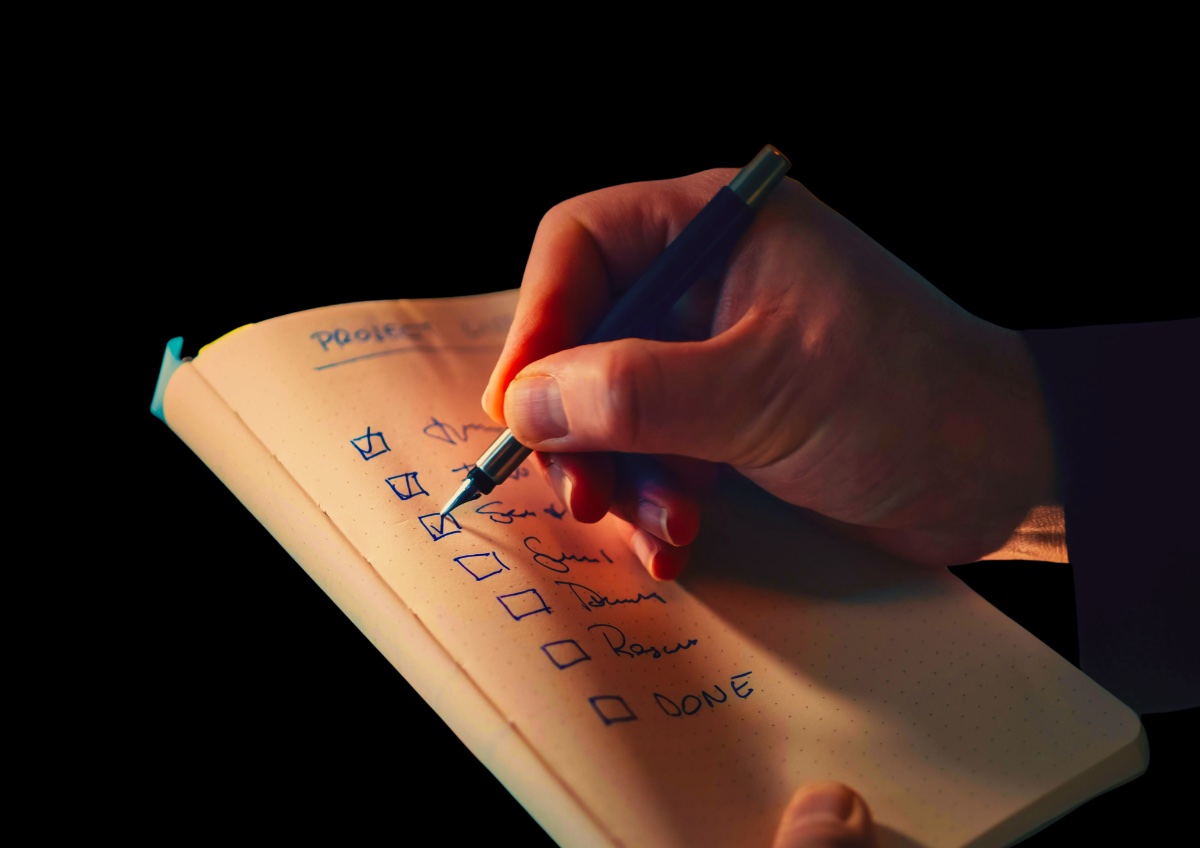
In your head, the slips merge into one big “it didn’t work again”. Written down, it turns out they always happen in the same places: at the same time of day, near the same object, in the same mood. One week is enough to see your own:
- Morning: one if–then plan. Write one for the day, for the point where you’re most likely to slip.
- Evening: where did you slip? One line about when and where you strayed from what you wanted. If nowhere, write that down too.
- What made it easy? What was within reach, what was in sight, what was your mood? The object, the place and the time say more than “I was weak”.
- One friction to add or remove for tomorrow. Just one: the phone to the kitchen, the workout clothes over the back of the chair.
- At the end of the week: the pattern. Which time of day, place or situation kept coming back? Which friction worked? Keep that one, and pick a new one for next week.
The journal isn’t a list of failures, it’s a map. After a few days many people are surprised that most of their slips are tied to one single situation — and one well-chosen friction changes more than a month of resolutions.

In short
- According to research, people with high self-control meet fewer temptations; they don’t necessarily resist better.
- The idea of “running out of willpower” is contested: the large multi-lab replication found an effect close to zero.
- The strongest tools: friction, if–then plans, fewer decisions.
- Forming a habit takes weeks, even months, and one missed day doesn’t ruin it.
- After a slip, self-compassion, not self-blame — and a week of friction journaling shows where change is worth making.
When it’s more than self-discipline
If all your life you’ve felt that however much you plan, your attention scatters, deadlines slip and even planning itself is impossible to carry out, it’s worth checking whether this is about regulating attention. Our article on adult ADHD helps you gather what’s worth showing a professional. If listlessness and numbness have lasted for weeks, that can be a sign of depression; if work has drained your energy, burnout. These aren’t self-discipline questions and they aren’t solved by design — in those cases it’s worth talking to a doctor or a psychologist.
This article is about self-observation; it doesn’t replace a doctor or a psychologist. And if you reach the point where you don’t want to live, ask for help right away: a local crisis line, an emergency number, or a person you can call.
Where a system helps
Self-discipline weakens most at two points: you don’t remember where you slipped, and you don’t see how much went well in the meantime. Both need writing things down.
In Mirrify, the friction journal lives in your morning and evening reflection: the if–then plan in the morning, the slip and what made it easy in the evening. The habit tracker shows how a habit develops over weeks, missed days included, and the three daily priorities make the morning decision shorter. The AI mentor uses your own entries to show you recurring patterns — for example which time of day or situation your slips are tied to.
What it doesn’t do: it doesn’t block apps, it doesn’t watch over you, it doesn’t “make you disciplined”, and it isn’t therapy. Building friction into your surroundings is up to you; the system helps you see which one works.
The one sentence worth taking with you
If you take only one thing from all this, let it be this: self-discipline isn’t defeating temptation, but designing a day in which you have to defeat it less often — and when you slip, it says nothing about your character, only about the plan, which can be improved.
And if you can only do one thing right now: think of the situation where you slip most often, and add one single friction to it today. In the evening, write down in one line what happened.
Frequently asked questions
How can I become more disciplined?
Don’t try to increase your willpower; reduce the number of situations in which you have to resist. Raise the cost of the unwanted behaviour (charge your phone in another room), lower the cost of the wanted one (lay out your workout clothes), write if–then plans for the hard moments, and set defaults so you have fewer decisions to make. According to research, disciplined people largely live like this: they meet temptation less often.
Is it true that willpower runs out like a muscle’s strength?
That’s the so-called ego depletion theory, from experiments by Roy Baumeister and colleagues in 1998. A pre-registered replication in 2016, carried out across more than twenty labs with more than two thousand participants, found an effect close to zero. The debate isn’t closed, but today this much can be said: “running out of willpower” is a contested idea, not a proven fact. Tiredness, hunger and stress still genuinely make evenings harder.
How can self-discipline be developed?
Mostly by designing your surroundings and your habits. According to meta-analyses on self-control, self-discipline is more strongly linked to habitual, automatic behaviour than to restraint in the moment. So it’s worth turning a good behaviour into a routine (a fixed time, the same first step), moving tempting things further away, and being patient: forming a habit takes weeks, often months.
What is an if–then plan?
An if–then plan (implementation intention) is known from Peter Gollwitzer’s research: you write down in advance what you’ll do in a given situation. For example: “If I pick up my phone after nine in the evening, then I’ll put it on the charger and pick up the book.” That way you make the decision with a calm head, and in the moment you only have to carry it out. According to a 2006 meta-analysis by Gollwitzer and Sheeran, the method helps people reach goals with a medium-to-large effect.
How long does it take to form a new habit?
In a 2010 study by Phillippa Lally and colleagues, the median was roughly 66 days, but the spread was enormous: from 18 to 254 days, depending on the behaviour and the person. The “21 days” doesn’t come from research. The same study also showed that missing a single occasion did not meaningfully derail the habit forming.
What should I do if I slipped and broke my resolution?
Instead of blaming yourself, look at what made the slip easy: the place, the time, the mood, an object within reach. That shows you where a friction is needed. Treat yourself the way you’d treat a friend: shame tends to lead to avoidance, not better behaviour. As a practical rule of thumb, “don’t miss twice in a row” works well: one missed day is an accident, two is the start of a new pattern.
Can a lack of discipline be a sign of ADHD or depression?
It can, but not every self-discipline problem is. If all your life you’ve felt that your attention scatters, deadlines slip and even planning is impossible to carry out, it’s worth checking with a professional whether it might be ADHD. If numbness and joylessness have lasted for weeks, that can be a sign of depression; if work has drained your energy, burnout. In those cases it’s worth talking to a doctor or a psychologist, and if you don’t want to live, ask for help right away.
Mirrify
Turn reading into practice
Mirrify brings your journal, habits, goals and an AI mentor that works from your own data into one place.
- Journal, morning and evening reflection, habits, goals and to-dos — in one system.
- An AI mentor that remembers your earlier entries and shows you your patterns.
- Write with no connection: it syncs as soon as you are back online.
Also worth reading from the Knowledge Base
 Daily practiceBuilding habits: how to form a new habitCue, small version, if–then plan.17 min→
 GoalsSystems instead of goals?The advice many people misunderstand.12 min read→
 Daily practiceHow to stop procrastinatingThe feeling behind the task.17 min→
 Self-knowledge“I have no motivation”Why motivation isn’t what’s missing, and what comes instead.13 min read→
 Self-knowledgeReparentingReparenting is not coddling and not self-absolution: it is the replacement…10 min read→
 Daily practiceHow to hold yourself to something when nobody is…It does not take willpower.11 min read→