Knowledge base › Daily practice
Do daily affirmations actually work? What the science says

Affirmations can work, but not the way social media sells them. Empty, over-positive mantras do little for most people, and for some they backfire. What research supports is different: believable, values-based, process-focused statements, backed by action. This article shows the difference and how to write ones that actually matter.
The short, honest answer
Yes, affirmations can work, but not in the form most people know. The „I am rich and successful" type of mantra, repeated out loud in the mirror, rarely produces lasting change for most people, and for some it does the opposite. The problem is not the idea of affirmation. It is the execution.
Science supports one specific thing: self-affirmation. This is not forcing reality with positive words. It is a moment where you remind yourself of what truly matters to you. The difference sounds subtle, but for the outcome it is decisive. One is hopeful self-deception; the other is a measurable psychological tool.
If you have tried affirmations and felt nothing, the fault is probably not yours. You used the wrong tool in the wrong way. Let us look at what the research actually says.
To be clear, this does not mean affirmations are a useless fad. It means they have a credibility condition and an action condition, and once you meet both, they become a real tool. The rest of this article unpacks exactly those two conditions, grounded in research and practical examples.

What the science says: self-affirmation theory
Psychology has a well-studied area called self-affirmation theory. Its core is not saying positive things about yourself, but reaffirming your core values: what genuinely matters to you, whether that is family, honesty, creativity or learning.
Research shows that when people briefly reflect on an important value before a threatening or stressful situation, they handle the pressure better. Values-based affirmation buffers the stress response, because it reminds you that your self-worth does not hinge on this one situation. You respond with more perspective and less defensiveness.
Notice the difference: this is not lying to yourself that everything is fine. It is placing yourself in a wider context. Not „I am perfect", but „I am more than this single moment". This kind of affirmation stabilizes you rather than pumping you up.
Why affirmations sometimes backfire
There is an uncomfortable research finding that motivational content rarely mentions: overly positive affirmations tend to hurt exactly the people who need help most. In a well-known study, people with low self-esteem felt worse after repeating „I am a lovable person" than people who did nothing at all.
The reason is simple and human. When a statement sits too far from what you actually believe about yourself, your mind does not accept it, it starts arguing back. With every repetition it drags up the counter-evidence: „No I am not, remember yesterday?" The mantra does not reinforce; it keeps spotlighting the gap between where you are and where you want to be.
This credibility gap is the central problem. An affirmation only works if your mind can at least half accept it. If it cannot, every repetition is a small internal argument that you keep losing. So the fix is not saying it louder or more often. The fix is bringing the sentence closer to reality.
In practice, bold affirmations do no harm to people who already have high self-esteem, because there is nothing to argue against. But if you are having low days, the best thing you can do is dial the grandeur down. A smaller, more believable sentence is not timidity, it is strategy: it gives you a foundation you can actually build from, rather than a peak you fall off every day.

How to write affirmations that actually help
A good affirmation is not a slogan. It is a precisely worded, believable statement that you back with action. Build it on four traits: make it believable, process-focused, values-based and tied to evidence. Here is how to put one together.
A useful test before you accept a sentence: say it in your head and watch your body. If you tense up or a small voice objects right away, the sentence is still too far. If you feel calm or a slight lift, you are in the right place. Your mind is surprisingly precise about what it can accept; it is worth listening to rather than overriding.
- Start from a real value. Ask yourself what genuinely matters in this situation. Not the outcome, but the value: courage, patience, honesty, care. Build the affirmation on that.
- Word it believably. Choose a sentence your mind can at least half accept. „I stay calm in every situation" is too big. „I am getting better at handling pressure" is acceptable and still lifts you.
- Point at the process, not the end state. Instead of „I am a millionaire", try „Every day I take one step toward my financial security." The process is in your hands; the end result is not fully.
- Tie it to evidence. The strongest affirmation states something you can point to. „I am someone who finishes what they start" works if you can recall three things you actually finished.
- Use it at decision points. Do not just recite it in the morning. Recall it when you have to choose: put the phone down, go to the gym, say the hard thing. That is where it earns its value.
Weak versus strong affirmations
The difference is not in the positivity, but in the believability and the focus. The examples below express the same desire yet land completely differently in your mind.
Weak: „I am extremely confident." → Strong: „I speak up more easily when I have something to say."
Weak: „Everyone loves me." → Strong: „I show up for the people who matter to me."
Weak: „I am wealthy." → Strong: „Every day I make one responsible choice with my money."
Weak: „I never procrastinate." → Strong: „Today I take the first small step before anything else."
Notice the pattern: the weak versions assert an end state with no call to act. The strong ones describe a present-tense, believable process in motion, something you can do today.
Saying it or writing it?
Both have a place, but writing has one advantage: it slows you down. When you write an affirmation, you have to walk through it, phrase it, and you naturally notice whether you believe it. Saying it out loud easily turns mechanical, the words spinning by without thought.
Writing also makes it easy to tie to evidence. Write the sentence, then one small piece of proof from today that supports it. That way the affirmation is not detached from reality; it gets embedded in it. This is exactly the mechanism that closes the gap in your mind.
If you like the spoken version, keep it, but add the written, evidence-backed form too. The two together are far stronger than mirror-reciting on its own.
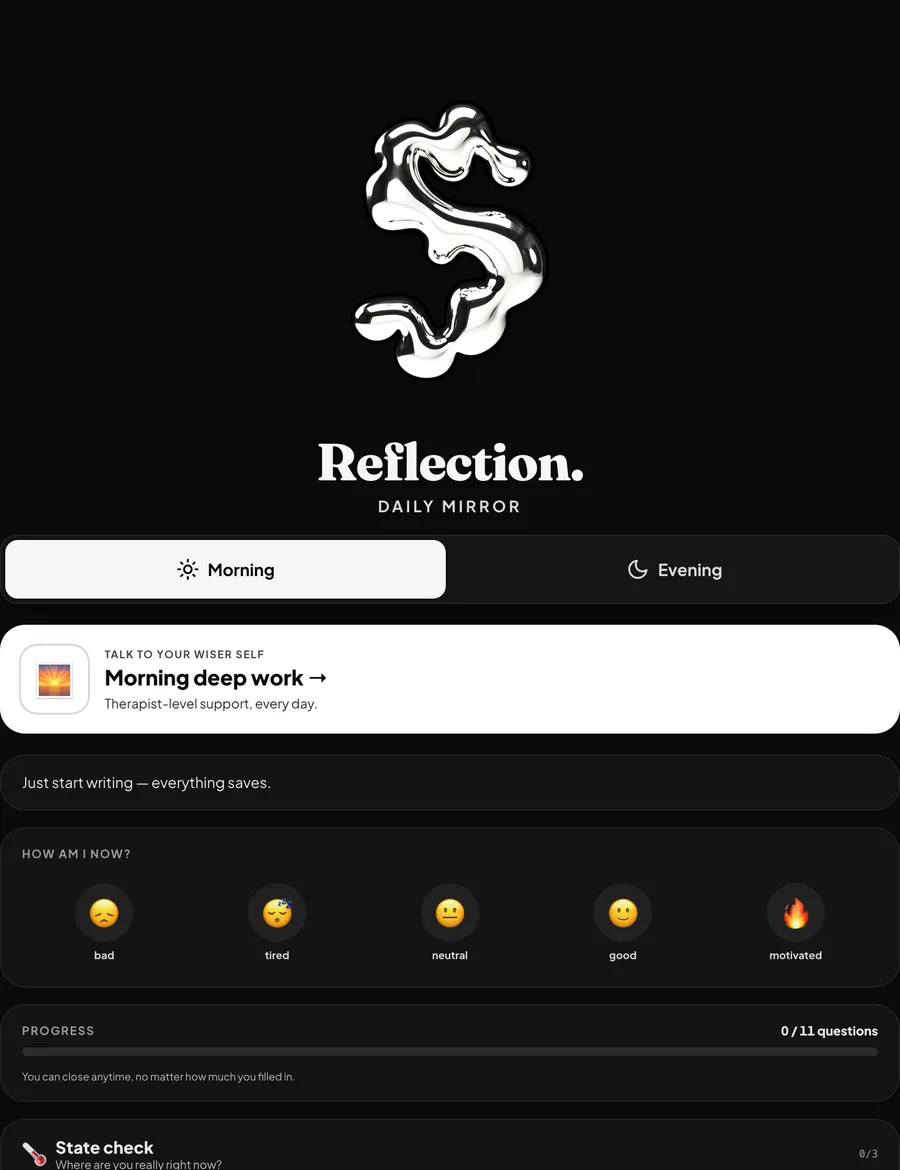
An affirmation without action is empty
Here is the most important part that most content skips: an affirmation on its own changes nothing. It is not a spell. Its effect comes from opening the right direction, lowering stress and reminding you of your value, but the change comes from action.
Think of it as a warm-up. An athlete's warm-up does not win the race, but it prepares the body for it. The affirmation prepares your mind for the decision you then have to make. If no action follows the sentence, it was just a nice feeling that evaporates by evening.
So the strongest affirmation is always tied to an action. Not „I am brave", but „today I say the one thing in the meeting." The sentence and the action close a loop together: the affirmation sets the intention, the action provides the evidence, and the evidence makes the next affirmation more believable.
Pair the affirmation with a goal and a habit
An affirmation levels up when it becomes part of a system. Pick a value, write it a believable, process-based sentence, then attach a concrete goal and a daily habit that proves it. Now the affirmation is not floating in the air; it has something to hold on to.
Example: the value is discipline. The affirmation: „I am someone who takes the small daily step." The goal: four workouts a week for a month. The habit: five minutes of movement every morning. Now the affirmation gets a checkmark from reality every day. The sentence and your life keep moving closer, and that is exactly what makes it believable.
This is the point where the affirmation stops being a wish and becomes a self-fulfilling feedback loop. You do not believe it because you said it many times; you believe it because you are collecting evidence for it day by day.
One thing to avoid: do not attach five affirmations to five goals at once. The system holds up when you focus on one or two values at a time. Too many sentences lead to the same place as one oversized sentence: there is not enough evidence for each, and the affirmation rings empty again. Fewer sentences, more backing.

How Mirrify ties affirmations to your values
Mirrify is built so an affirmation never stays an isolated mantra. First it helps you clarify your values, because without them every affirmation is guesswork. From there it suggests sentences that are believable and built from your own words, not a generic list.
Then the system ties the affirmation to your goals and daily habits, and every day it looks for the evidence in your journal and habit tracker. So the affirmation does not overwrite reality; it slowly aligns with it. The AI mentor works from your own entries, so its feedback is about you, not a template.
Over time the system also gives you feedback: you can see which affirmations are actually accumulating evidence and which stay empty. That is an honest mirror. If a sentence has gone months without any backing, that is not failure, it is a signal that it is either too big or not really your value. You rephrase it and move on.
If affirmations have not worked for you so far, try it this way: a believable sentence, a real value, one goal, one habit, daily evidence. That is no longer self-deception. It is a self-knowledge system that turns insight into measurable change.
Frequently asked questions
Do daily affirmations actually work?
They can, but not as over-positive, mirror-recited mantras. Research supports values-based self-affirmation: when you reflect on a value that matters, your stress drops and you decide more clearly. Believable, process-focused statements backed by action work; empty superlatives do not.
Why do affirmations make me feel worse?
Most likely the gap between the sentence and what you actually believe about yourself is too big. For low self-esteem, an over-positive claim triggers resistance: your mind argues back and spotlights the shortfall. The fix is not louder repetition but a smaller, more believable, process-based sentence.
Should I say or write my affirmations?
Writing is often stronger because it slows you down and forces you to notice whether you believe the sentence. Write the affirmation, then one small piece of proof from today that supports it. That ties the affirmation to reality instead of detaching from it. You can keep the spoken version too.
What does a well-written affirmation look like?
Believable, present-tense, process-focused and rooted in a value. Instead of an end state, it states the step: not „I am confident", but „I speak up more easily when I have something to say". And it always has an action that proves it, otherwise it stays just a nice feeling.
Is affirming enough, or do I need action?
An affirmation is a warm-up, not the race itself. It sets the intention and lowers stress, but the change comes from action. The strongest approach ties the sentence to a goal and a daily habit, so real evidence accumulates every day, which makes the next affirmation more believable.
How does Mirrify help with this?
Mirrify first helps you clarify your values, then suggests believable affirmations built from your own words. It ties the sentence to your goals and habits and looks for daily evidence in your journal. So the affirmation is not an empty mantra but part of a self-knowledge system with measurable change.
Mirrify
Turn it into self-knowledge — in Mirrify
Mirrify is a self-knowledge system: journal, goals, habits, wheel of life and an AI mentor that knows you from your own words and turns insight into measurable change.
- Journal, morning and evening reflection, habits, goals and to-dos — in one system.
- An AI mentor that remembers your earlier entries and shows you your patterns.
- Write with no connection: it syncs as soon as you are back online.
Related from the knowledge base
 Direction & valuesHow to find your valuesThe basis of an affirmation.8 min→
 Daily practiceGratitude journalEvidence for the affirmation.15 min→
 Daily practiceHabit buildingBacked by action.17 min→
MirrifyThe self-knowledge system.→
Daily practiceHabit buildingBacked by action.17 min→
MirrifyThe self-knowledge system.→
 Daily practiceThe daily top threeWith three it isn’t the number that matters, it’s the limit.11 min read→
 Daily practiceEvening routineAn evening routine that actually works: close the open loops, plan…7 min→