Knowledge base › Self-knowledge
How to Know Yourself: A Practical Guide to Building Self-Awareness

Getting to know yourself isn't one big revelation. It's a skill you practice over months — much like learning a language. And it comes with an uncomfortable twist: from inside your own head, you can't see the very things you most need to see. That's why looking inward on its own isn't enough. Below: what self-awareness actually is (it has two layers, not one), why we get ourselves wrong, a 7-step method you can realistically follow, and the signs that tell you it's working.
What self-awareness really is — and why it has two layers
Self-awareness is knowing what you think, what you feel, what drives you, and how you react to what happens to you. That's the easy part. The harder part is that this knowledge comes from two sources that are surprisingly independent of each other.
- Internal self-awareness: how clearly you see your own values, feelings, wants, and the pattern of your reactions. This is what most people mean when they talk about knowing themselves.
- External self-awareness: how accurately you see the way you come across to others — how your tone lands in a meeting, what your partner feels when you're “just tired”.
Organizational psychologist Tasha Eurich popularized this distinction in her work. One of her key observations was that the two don't go together: someone can understand their inner world in depth and have no idea what impression they make — and the reverse, someone can know exactly how others see them without knowing what they themselves want. Full self-awareness needs both, and most of the learning happens in the gap between them.
An older, equally well-known model draws the same picture: the Johari window (the work of Joseph Luft and Harrington Ingham) splits what can be known about you into four panes. Some things both you and others know; some only you know; some nobody knows; and one pane holds what others can see but you can't. That's the blind spot — and it's the part you will never find by looking inward.
Self-awareness isn't what you think about yourself. It's what the pattern of your behavior reveals about you.
Which leads to the most practical point of all: self-awareness is a skill, not an event. It doesn't arrive after a retreat weekend or one deep conversation. It comes from the habit of regularly looking at what you did and giving an accurate name to what you see.

Why looking inward isn't enough
From the inside you see your intentions — “I meant well”, “that's not what I meant” — while the people around you only see your behavior. This intention–impact gap is the first reason we routinely get ourselves wrong. Not out of stupidity, but because of where we're standing.
The second reason is that the brain produces explanations nonstop. When you react badly, you don't log “I was irritable”; you log “they provoked me”. That protects your self-image, and it also blinds you. One of Eurich's recurring observations is that far more people consider themselves self-aware than actually are — in other words, most of us believe we know ourselves well, which is exactly why we never check.
The third reason is the most surprising: lots of introspection doesn't, by itself, make you more self-aware — it easily tips into rumination. One of the most quoted ideas from Eurich's work is that asking “why?” — “why am I like this?”, “why do I always do this?” — often produces not the truth but a plausible, wrong explanation that we then cling to. “What” questions give you more: what was it about this situation that bothered me so much? What happened right before? What would I do differently?
Three blind spots nearly everyone has:
- The intention–impact gap. You measure what you meant; others measure what you did.
- After-the-fact reasoning. You react first, and your brain supplies a logical reason afterwards.
- A different excuse every time. Same conflict, same procrastination — but each time you blame a different circumstance.
The method: 7 steps you can actually stick with
If you can't see yourself clearly from inside your head, you have to get it out of your head. That's what writing is for. A written sentence slows a thought down enough for you to examine it, and it creates dated self-data you can reread later. Today's memories are edited by today's mood; the entry you wrote three weeks ago doesn't flatter you.
Consistency beats length: five honest lines a day are worth more than one long essay a month. (If you've never kept a journal, how to start journaling is a good entry point.) You don't need to start all seven steps at once — begin with the first and add one each week.
- Record one scene a day. Three or four sentences in the evening about a single moment: what happened, what you did, what you felt. Don't judge, just record — “I interrupted Anna twice in the meeting”, not “bad day”.
- Name the feeling precisely. Not “it was bad” but: disappointed, humiliated, impatient, relieved. The precise word is half the insight — and it already takes some of the edge off.
- Ask “what”, not “why”. What exactly bothered me? What was I trying to achieve? What happened just before? “What” gives you data; “why” often just gives you another story.
- Separate intention from decision. Two columns: what you intended, and what you actually did. “I wanted to work out” isn't a decision, it's a wish. The gap between the two columns is your most honest mirror.
- Ask for one outside view a week. One person, one specific situation: “When I shut the discussion down yesterday, how did that land with you?” No defending, no explaining — say thanks and write it down.
- Reread once a month. Half an hour with the month's entries. Three questions: what kept coming back, what surprised me, and what do my notes show that I haven't said out loud yet?
- Write one testable sentence. At the end of the month, one statement about yourself that the data supports — “when I'm tired, I hear every request as a personal attack” — and watch next month whether it holds.
This loop — record, reread, one testable statement — is what turns self-awareness into a skill. Volume isn't what matters; closing the loop is: you collect data, look for a pattern, form a hypothesis, and check it in the next round.
The outside mirror: feedback, body, decisions
By definition, you can't find a blind spot alone. You need something from outside — and three kinds of “outside” are always within reach.
Other people's feedback. Most feedback is useless because we ask for it badly. “What am I like?” is too broad and gets you polite nothing. A good question targets one specific behavior and goes to someone close enough to see you and honest enough not to sugarcoat. The hardest part comes after: not getting defensive. Defensiveness is the instinct that keeps a blind spot alive. If that's hard for you, the article on receiving criticism adds a 24-hour rule.
Your body's signals. The body often knows before the conscious mind does: your stomach tightens before an email, you get drained around a certain person, you light up with a particular kind of task. Add one word about your body to the daily scene — tight shoulders, heavy chest, light — and within a few weeks you'll see what really fills you up and what drains you.
The trail of your decisions. Your calendar and your bank statement say more precisely what matters to you than any self-description. What counts isn't what you say but where your time and money went last month.
A note on tests: a good personality test can give you vocabulary and a starting point, but it works from your own answers — so it measures your internal self-awareness, not your blind spot. What each test actually measures, and how to use one wisely, is covered in the self-knowledge test article.
Your values: where who you are gets decided
It's hard to know who you are if you don't know what matters to you. Values aren't nice words on a list; they're the principles you're willing to give something up for. What you only stand for when it's convenient is an opinion; what you sacrifice for is a value.
The most useful ground is value conflict: when two important things collide — accuracy and speed, family and career, peace and truth. These moments aren't mistakes, they're information: where your hardest decisions are, what truly matters to you comes into view. If you want to work through this methodically, how to find your values gives you four proven exercises.
Hunting for recurring patterns
A single insight is worth little — a pattern tells you almost everything. The real ground of self-awareness is repetition: the same type of conflict in your relationships, the same procrastination on the same kind of task, the same strong reaction in the same situation. Once can be chance; the third time is a system. That's why rereading is essential: you only see a pattern across several data points.
Three signs you've found one:
- Repetition. Same situation, different people, same outcome.
- Disproportionate reaction. The feeling is stronger than the situation warrants — usually something older is at work.
- A recurring sentence. The same excuse or accusation keeps showing up in your notes: “they left it to me again”, “nobody listens anyway”.
When you find a pattern, don't judge it straight away — first understand what it protects. Procrastination often hides fear of failure; withdrawal often hides hurt. The goal isn't self-punishment but the sentence: “ah, it's this pattern again.” That recognition is the first step out. If you're stuck on what to ask during your monthly reread, the self-discovery questions collection gives you material grouped by theme.
In short
- Self-awareness has two layers: internal (what you feel, what drives you) and external (how you affect others) — and they don't go together.
- You can't find a blind spot by looking inward: you need feedback, reread self-data, and the trail of your decisions.
- Ask “what”, not “why” — “why” often just manufactures another explanation.
- The heart of the 7 steps is a loop: daily recording, monthly rereading, one testable sentence.
- You can measure progress: better predictions, fewer surprises in feedback, a shorter gap between reaction and recognition.
How do you know your self-awareness is growing?
One trap in developing self-awareness is that there's no scoreboard, so it's easy to “work on yourself” for months while nothing changes. Yet there are signs you can check from the outside. Six worth watching:
- You predict better. You can say more and more accurately in advance how you'll react to a situation — and afterwards it turns out you were right.
- Feedback surprises you less. What others say about you is increasingly something you've already written about yourself.
- Your words get sharper. In your notes, “bad”, “weird”, “stressed” give way to more specific feeling words.
- Recognition gets faster. At first you realize what happened days later; then hours later; eventually you notice it in the middle of the situation.
- Your monthly sentences hold up. More and more of your testable statements turn out to be true — meaning you're reading your data better.
- You exit the loop sooner. The same pattern still shows up, but you don't play it out: you stop at the third sentence.
You can measure the first sign with a simple prediction test. On Sunday evening, write down three situations that are certain to come up next week — a meeting, a family lunch, a deadline — and next to each one sentence: I think I'll react like this. The following Sunday, check how many you got right. The goal isn't three out of three; it's for the ratio to improve month by month — and to learn the most from where you were wrong.
Where the limit is — common traps, and when to see a professional
Most people get stuck on one of three mistakes.
- Navel-gazing. Endless introspection with no action. Self-awareness isn't the goal, it's a tool: it exists so you decide differently. If you've been analyzing yourself for months but do nothing differently, that's rumination, not growth.
- Harsh self-judgment. If every insight turns into self-punishment, your brain learns to avoid honesty. Keep the tone of your observations curious, not accusing.
- The one-insight illusion. A good insight inspires, but it doesn't change you. Repeated practice does.
And sometimes working alone isn't enough. If trauma, abuse, or very strong old pain sits behind a recurring pattern; if self-reflection regularly leaves you worse off; if for weeks you haven't been sleeping, eating, or enjoying anything — that's not a journaling topic but something for a psychologist, therapist, or doctor. Even then, your journal can help: you'll be able to describe more precisely what's happening to you.
If you're in crisis
If you catch yourself not wanting to live, or wanting to hurt yourself, don't open your journal: get help right away. Call your local crisis line or emergency number (112 in the EU, 911 in the US, 999 in the UK), or someone you can call right now.
Where a system helps
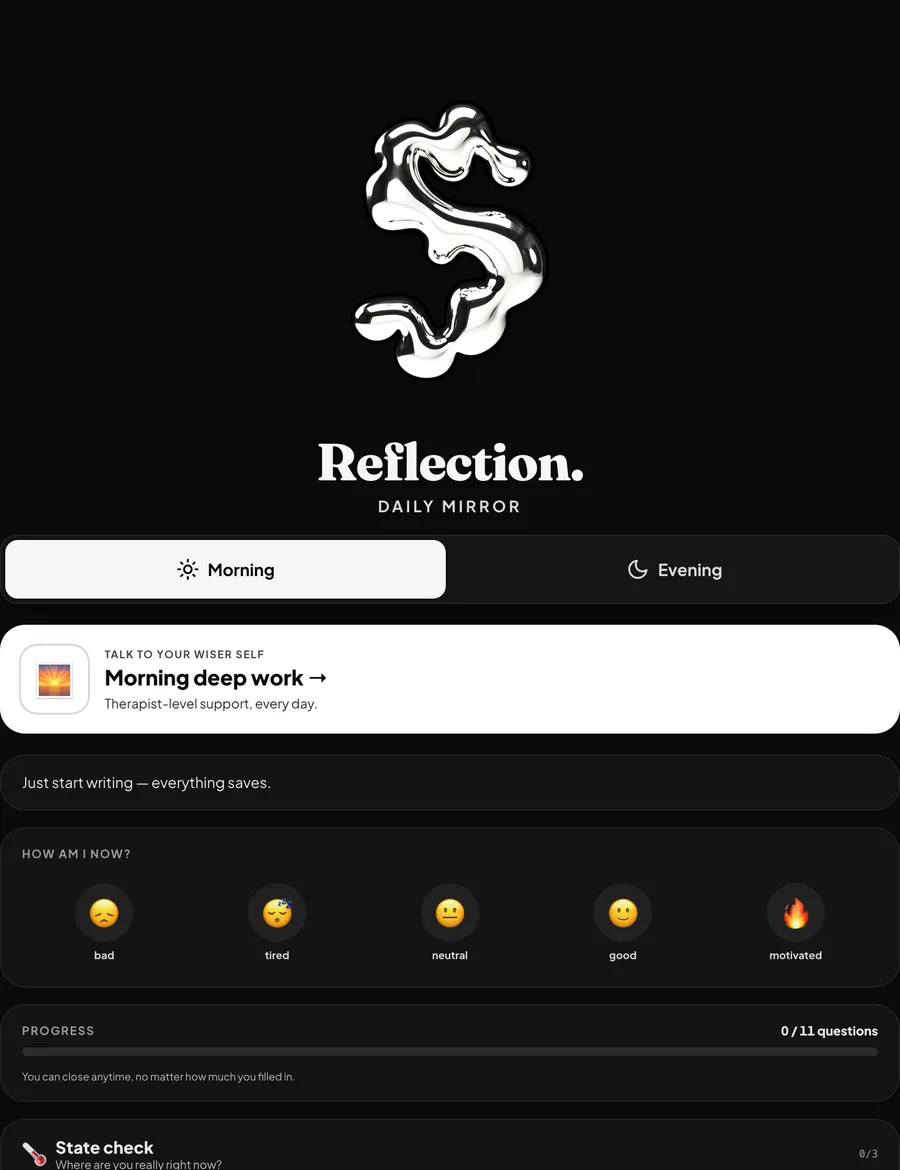
The biggest obstacle to the method is practical: your self-data gets scattered. A note on your phone, a mood you never wrote down, feedback you only kept in your head — separately they show nothing. A pattern becomes visible when it collects in one place and is actually in front of you when you do the monthly reread.
In Mirrify, your journal, morning and evening reflection, mood tracking, decision journal, life wheel, and values work live in one place, dated — so the daily scene, the intention–decision columns, and the monthly sentence don't live in three notebooks and two apps. In Pro, the AI mentor shows you what repeats, based on your own entries; the pattern recognition article explains this in detail. You can try Pro free for 14 days.
What it doesn't do: it doesn't get to know you for you, it doesn't diagnose, and it isn't therapy. You have to write the sentences and ask for the feedback. The system just makes sure that at the end of the month — and six months from now — there's something to reread.
The one sentence worth taking with you
If you take away one thing: getting to know yourself isn't looking inward, it's collecting data — from your own sentences, from other people's eyes, and from the trail of your decisions.
And if you do just one thing today: tonight, write down a single scene from your day, in four sentences, with one precise feeling word. That's step one, and it takes five minutes.
Frequently asked questions
What is self-awareness?
Self-awareness is knowing what you think and feel, what motivates you, and how you react to what happens to you. It has two layers: internal self-awareness (how clearly you see your own values, feelings, and patterns) and external self-awareness (how clearly you see how you affect others). The two don't automatically go together, so it's worth developing each one.
How can you develop self-awareness?
Through small, regular practices rather than one big revelation. The most effective is a simple loop: a few lines a day about a specific scene, with a precise feeling word; one specific question a week to someone you trust; a monthly reread, ending with one testable sentence about yourself. Instead of “why am I like this?”, ask “what”: what bothered me, what happened before, what would I do differently.
How long does it take to know yourself?
There's no finish line — self-awareness is an ongoing skill, not a state you reach. You'll usually see the first useful patterns after a few weeks of regular recording, once there's something to reread. Insights that actually change your behavior take months, because you can only recognize a pattern reliably across several repeated data points.
Is looking inward enough, or do I need outside feedback?
You need the outside view too. Introspection shows you your intentions and feelings, but by definition you can't find your blind spots — what others see in you and you don't — on your own. Ask for specific feedback on one behavior from someone close to you and honest, and don't get defensive when you hear it.
What's the difference between internal and external self-awareness?
Internal self-awareness is how well you understand your own inner world: your values, feelings, and reactions. External self-awareness is how accurately you know how others see and experience you. According to the work of organizational psychologist Tasha Eurich, each can be strong or weak independently of the other, so it's worth paying attention to both.
How do I know my self-awareness is improving?
Watch for these signs: you can predict more accurately how you'll react to a situation; feedback from others surprises you less often; you describe your feelings in more precise words; and you notice sooner when an old pattern kicks in. A weekly prediction test — three situations, three predictions, checked a week later — lets you track this in numbers.
Can a self-knowledge test help me know myself?
Partly. A good test gives you vocabulary and a starting point, but it works from your own answers — it measures what you think about yourself and won't reveal your blind spots. It's useful as a supplement, but it doesn't replace regular self-observation and outside feedback.
When should I see a professional about self-awareness issues?
If trauma, abuse, or very strong old pain sits behind your recurring patterns; if self-reflection regularly leaves you worse off; or if for weeks you haven't been sleeping, eating, or enjoying anything. A psychologist, therapist, or doctor can help. In a crisis, call your local crisis line or emergency number (112 in the EU, 911 in the US, 999 in the UK), or someone you can call.
Mirrify
Turn reading into practice
Mirrify brings your journal, habits, goals and an AI mentor that works from your own data into one place.
- Journal, morning and evening reflection, habits, goals and to-dos — in one system.
- An AI mentor that remembers your earlier entries and shows you your patterns.
- Write with no connection: it syncs as soon as you are back online.
Related from the knowledge base
 Self-knowledge50 self-discovery questionsFor going genuinely deep.17 min→
 Direction & valuesHow to find your valuesYour inner compass.8 min→
 Self-knowledgeSelf-knowledge without therapyAn 8-week practical guide.11 min→
 Self-knowledgeSelf-knowledge testSelf-knowledge test or personality test?8 min→
 Self-knowledgeReparentingReparenting is not coddling and not self-absolution: it is the replacement…10 min read→